CAST #P-7

PLAINVIEW POINT
COOPER COUNTY, MISSOURI
8,000 TO 7,000 B.C.

   Plainview points date to the Late Paleo-Indian and Early Archaic period (tradition) somewhere between 10,000 and 9,000 years ago and relate to a western bison hunting tradition. They were named after the Plainview site located in the High Plains of Texas where Sellards, Evans and Meade describe Plainview points in association with extinct bison. They are found over a wide area from Texas north into central Canada and from western Nebraska east to eastern Ohio. These points are Lanceolate in shape and are generally well made either with collateral (parallel) or random flaking. The bases are heavily ground and concave plus sometimes thinned.
   Isolated surface finds of Plainview points may not always be correctly identified. At the Rodgers Rock Shelter in Missouri both Plainview and Dalton points were found in the lowest levels along with fluted points. Some of these points could actually be one of the many different types of Dalton points. Some Goshen points from the Mill Iron bison kill site in Montana could also be mistaken for Plainview. As more sites are excavated and reference collections are expanded some of these identification problems may be worked out.

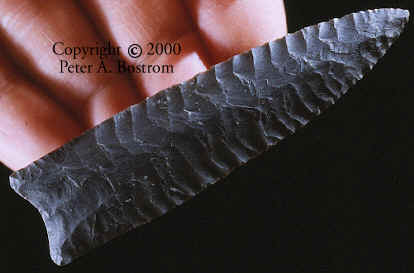
Plainview point hand held.
CAST #P-7
PLAINVIEW POINT
COOPER CO., MISSOURI
CHARLEY SHEWEY COLLECTION

   This Plainview point was found in 1981 by Sally McCall near Booneville, Missouri not far from the Missouri River. The Early Archaic craftsman who made it was very skilled at pressure flaking. This point is entirely finished with collateral (parallel) pressure flaking on both sides along with four or five thinning flakes on the base.
   Although most everyone calls this point a Plainview it could very well actually be more related to a form of Dalton point. At any rate it is a very good study piece that exhibits a skill level that is to be admired.
   This point was made of a good quality chert that may be Pitkin and it measures a little over 3 1/4 inches long.

HOME    ORDERING