|
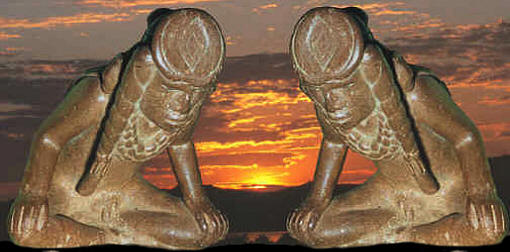
"---generally known as "Big Boy," (it) is
one of the most perfectly sculpted pieces that came from the (Spiro)
site".---1952,
Henry W. Hamilton, "The Spiro Mound," p. 34.
"----the idea of
statuary for statuary's sake had probably not been conceived. The life
forms shaped were generally the embodiment of mythic personages or
beings of importance in the mythology of the people".---1912,
Frederick Webb Hodge, "Handbook of American Indians North of
Mexico," part 2, p. 540.

"BIG
BOY"
PIPE
SPIRO MOUND SITE
Native American Indians were making tobacco smoking pipes for thousands
of years. Some of the finest examples were made of stone during the
Mississippian period in the eastern United States. The pipe illustrated
here represents one of the finest examples. It has been called the
"Big Boy" pipe ever since it was dug from Craig Mound in 1934
or 35. The mound was located on the
Spiro
Mound site in Le Flore County, Oklahoma. This pipe was sold
and resold over the years until it now resides in the collection of the
University of Arkansas.
|
|
CLICK ON
PICTURE FOR LARGER IMAGE
PHOTO BY BILL FECHT
"BIG BOY" PIPE
SPIRO MOUND SITE
LE FLORE COUNTY, OKLAHOMA
UNIVERSITY OF
ARKANSAS COLLECTION
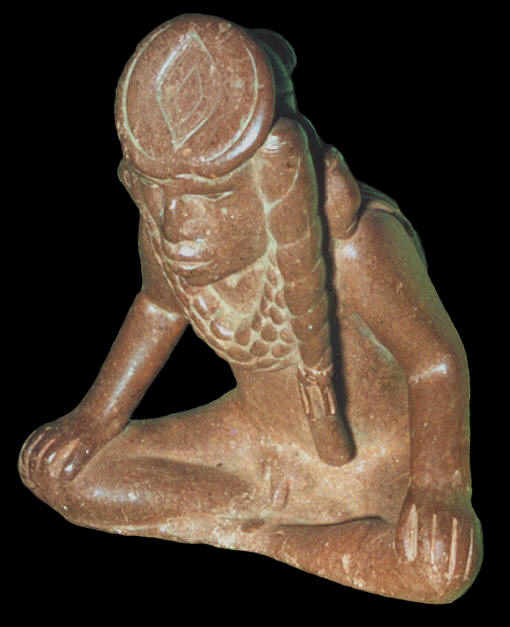
This picture shows the front view of the "Big Boy" pipe
from Spiro Mound. Visible features include multiple strands of
shell beads around the neck and one of the two large human maskette
ear ornaments. An impressive headdress with an ogee design and a
long single strand of braided hair have also been skillfully carved
into the pipe. This human figure is leaning forward in a cross-legged
posture and it has strong facial features. This pipe is made of
flint clay or fire clay and
it
measures 11 inches high and 9 inches wide. It weights 11 lbs. and 8
oz. |
|
|
Both
Woodland and Mississippian cultures in North America produced sculpted
human effigies in clay and stone. Many of these images are so well executed
they allow archaeologists to record very detailed information about the
people who made them. Native American artisans sometimes included such
things as hair style, jewelry, clothing and body posture into their
human effigy sculptures. The craftsman who made the "Big Boy"
pipe incorporated all of these characteristics. This pipe measures 11
inches (28 cm) high, 9 inches (22.8 cm) wide and it weights 11 lbs. and
8 oz.
|
|
CLICK ON
PICTURE FOR LARGER IMAGE
PHOTO BY BILL FECHT
"BIG BOY" PIPE
SPIRO MOUND SITE
LE FLORE COUNTY, OKLAHOMA
UNIVERSITY OF
ARKANSAS COLLECTION
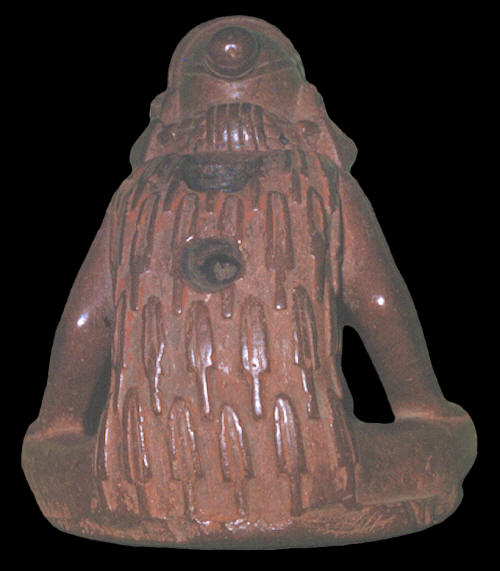
This picture shows the back of the "Big Boy" pipe. Two
holes can be seen. The upper one was used to hold the tobacco and
the lower one was used to withdraw the smoke. Tobacco
"cake" was observed in the concavity. This pipe was also
painted. Some of the red color can still be seen within the
indentations on the designs. There is also a topknot of hair at the
back of the head. The most sticking design on the back is the
feather mantle or cape which is carved with many images of feathers.
Charles C. Willoughby wrote an article called
"Textile Fabrics from the Spiro Mound." He comments that
"Feathered covered mantles were not uncommon throughout the
region of the United States in early Colonial times. He writes that
Lawson writes that "A doctor of the Santee Sioux was
"warmly and neatly clad with a match cloke, made of turkies'
feathers which makes a pretty show, seeming as if it was a garment
of the deepest silk shag (Lawson, 1860, p. 37)." |
|
|
The Spiro
Mounds "Big Boy" pipe probably represents a mythological
being. Frederick Hodge (1912: 492) states "It is believed that the
native artist drew, modeled or carved not with the subject before him,
but relying upon the traditional conception of the particular subject,
the mythological characters being of greater importance to him than the
literal or specific rendering of any original." The "Big
Boy" pipe is very well adorned with several strings of shell beads,
ear ornaments and a headdress. The hair is very well groomed with an
impressively long braid that extends down to the waist. A mantle or cape
with an intricate feather design also covers the back.
|
|
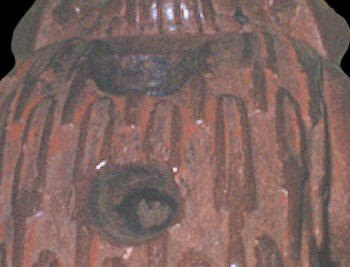
PHOTO BY BILL FECHT
"BIG BOY" PIPE
SPIRO MOUND SITE
LE FLORE COUNTY,
OKLAHOMA
UNIVERSITY OF
ARKANSAS COLLECTION
This picture shows a close up view of the back of the "Big
Boy" pipe. The two smoking concavities can be seen along with
the carved feathers on the mantle or cape. Residual traces of red
paint can still be seen on the surface. Mississippian craftsmen
painted many of their products.
Recent
work by Mary Vermillion shows that they also painted some
of their large bifacial Ramey knives with red and green pigments.
They also painted carved wooden objects and ceramics. |
|
|
The
"Big Boy" pipe has been described as being made of bauxite but
recent investigations by Dr. Thomas E. Emerson and Randall E.
Huges of Univ. of Illinois at Urbana and the Illinois State Geological
Survey are helping to identify the material these red stone pipes are made
of. Their research in geologic sourcing through x-ray diffraction and
spectroscopic analysis of Mississippian red stone pipes from southern
Illinois have shown that none of these pipes were made of bauxite or even
catlinite as have been previously reported. They have identified the
material this pipe and other examples were made of as flint clay or fire
clay from local sources in Missouri. It's a clay that has been
geologically compressed into a stone that can be carved into pipes. It's
also a material that is compatible with high heat.
The "Big Boy" pipe is as close to a photograph of a living
person from ancient Spiro Mounds that archaeologist could hope for. The
skilled craftsman who made it left behind his concept of a human figure
that may have been a mythic being but he also produced an important
visual document of his peoples' history.
|
|
"REFERENCES"
1912,
Frederick Webb Hodge, "Handbook of American Indians North of
Mexico," part 2, p. 540.
1952,
Henry W. Hamilton, "The Spiro Mound," p. 34-35
2000, "Figurines, Flint Clay Sourcing, The Ozark Highlands,
and Cahokian Aquisition", American Antiquity, 65 (1), by Thomas E.
Emerson and Randall E. Hughes.
2003, "Prehistoric American," vol. 37, no. 3, p. 48.
2004, Merriam,
Larry G. & Merriam, Christopher J., "The Spiro Mound: A Photo
Essay," pp. 16 & 108-109.
|
|
HOME
ORDERING |